

From $0 → $50K/Month Using Meta Ads for a Luxury Footwear Brand
Every luxury brand begins with a story. Sometimes it starts with craftsmanship, sometimes with design, and sometimes with a vision to create something that feels timeless. But when that brand enters the digital world, storytelling alone is not enough. Visibility becomes the real challenge.
A premium product deserves a premium audience. The difficulty is connecting the two.
This case study explores how a luxury footwear brand like Rondyce could scale its online revenue using a structured Meta advertising strategy. The goal is not simply to run ads, but to build a predictable growth system that introduces the brand to new customers, nurtures interest, and converts high-intent buyers.
The strategy begins with a simple question: how can a luxury brand turn social media attention into consistent revenue?
To answer that, we first look at the business fundamentals.
Business Context
Luxury footwear operates in a very different market compared to fast fashion or mass retail. Customers are not only paying for the product; they are paying for the story behind it.
Craftsmanship, materials, exclusivity, and brand identity play a major role in purchasing decisions. Because of this, advertising must communicate value rather than just price.
For this growth strategy, the following assumptions help define the advertising approach.
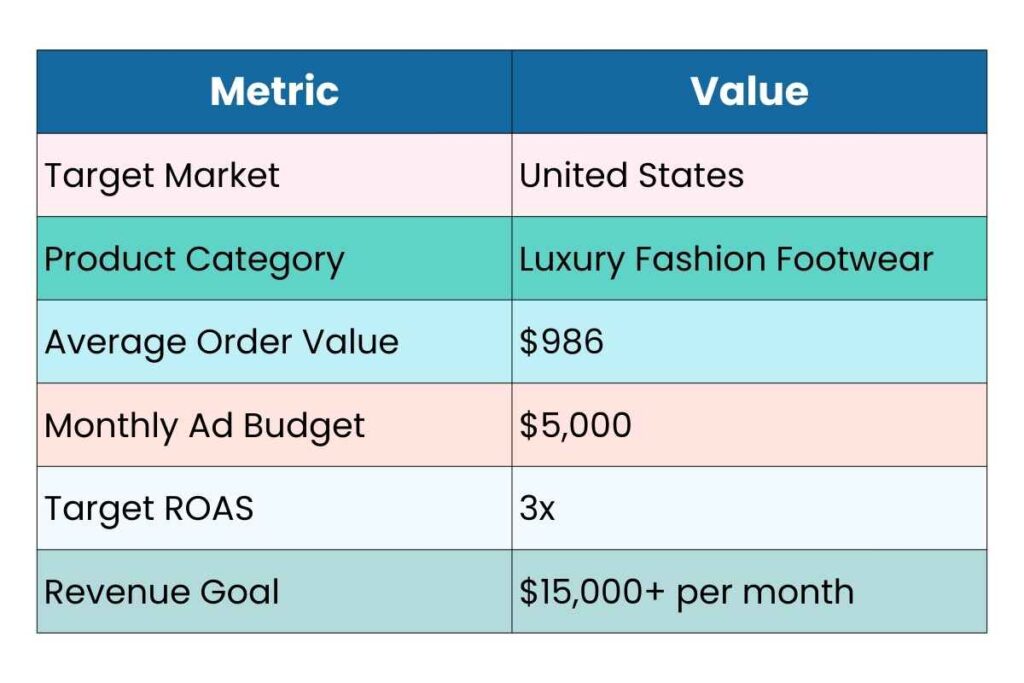
The numbers reveal something interesting. Because the average order value is close to one thousand dollars, the brand does not need hundreds of orders each month to become profitable. A relatively small number of conversions can generate significant revenue.
This allows the strategy to focus on reaching the right audience rather than simply chasing volume.
The Challenge of Selling Luxury Products Online
Luxury products behave differently in digital advertising environments. Most customers do not buy the first time they see a product. They often explore the brand, look at details, compare designs, and return later.
That means the advertising strategy must follow the natural behavior of luxury shoppers.
Some of the most common challenges include:
- limited brand awareness for emerging labels
- longer purchase decision timelines
- higher customer acquisition costs
- the need for strong visual storytelling
A successful advertising strategy must address these challenges by creating multiple touchpoints between the brand and the customer.
Designing the Advertising Funnel
Instead of running a single campaign focused only on purchases, the strategy uses a full-funnel system that gradually moves customers from discovery to conversion.
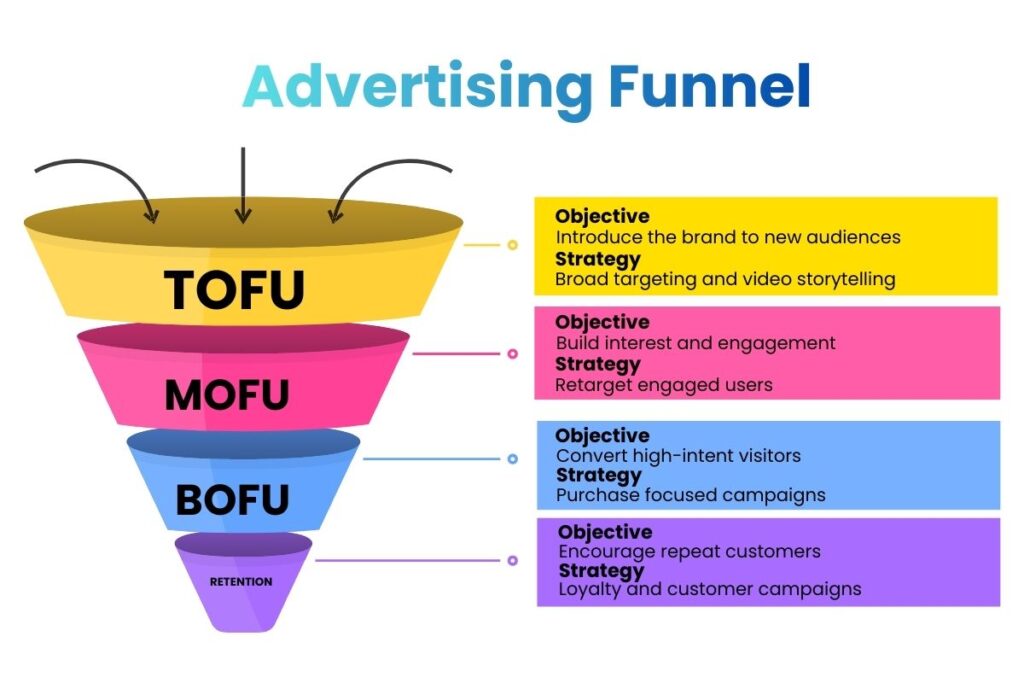
Each stage serves a different role in the growth process.
The top of the funnel is responsible for introducing the brand to people who have never heard of it. The middle of the funnel builds familiarity and trust. The bottom of the funnel focuses on conversions, while the retention stage strengthens long-term customer relationships.
This layered structure allows the advertising system to operate like a pipeline that constantly feeds new potential buyers into the brand ecosystem.
Budget Allocation Strategy
A balanced funnel requires thoughtful budget distribution. For a monthly advertising budget of five thousand dollars, the following allocation creates a sustainable growth cycle.
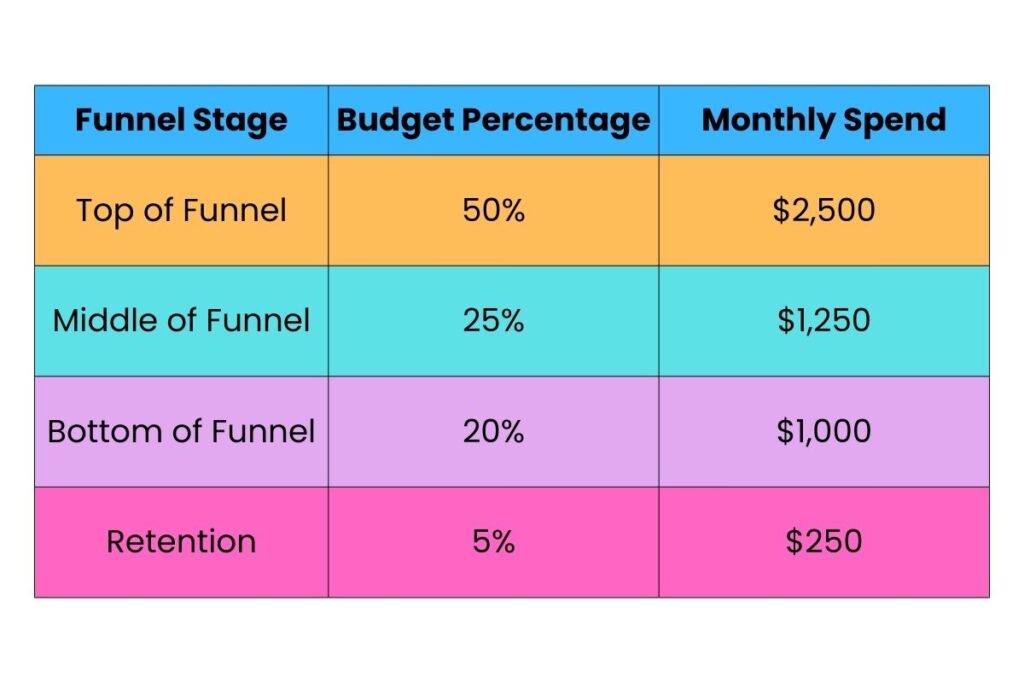
The largest share of the budget is invested in audience discovery. This ensures the brand continuously reaches new potential customers while the lower funnel campaigns focus on converting those who have already shown interest.
Campaign Structure: Why Each Campaign Has a Role
Each campaign in a Meta Ads strategy should have a clear purpose. Successful advertising rarely relies on a single campaign focused only on sales. Instead, it works as a system where every campaign supports a different stage of the customer journey.
Prospecting Campaign
The prospecting campaign introduces the brand to potential buyers who match the profile of luxury fashion consumers.
Possible targeting layers include:
- broad U.S. audience targeting
- luxury fashion interests
- designer footwear enthusiasts
- online luxury shoppers
Creative content at this stage focuses on visual storytelling rather than direct selling.
Lifestyle videos, cinematic product shots, and short brand narratives allow audiences to discover the brand naturally within their social media feed.
Consideration Campaign
Once users interact with the brand, they move into the consideration stage.
This audience may include:
- people who watched video ads
- users who engaged with social media content
- visitors who explored the website
At this point, advertising shifts toward deeper storytelling. The ads may highlight the craftsmanship behind the footwear, the materials used in production, and the design philosophy behind the collection.
The objective is not only to remind the user about the brand but also to strengthen the perception of quality and exclusivity.
Conversion Campaign
The conversion stage focuses on people who have already demonstrated strong purchase intent.
These users may have:
- viewed specific products
- added items to their cart
- initiated checkout but not completed the purchase
Messaging here becomes more direct.
Examples include:
limited availability messages
customer testimonials
product benefit highlights
These campaigns are designed to remove the final hesitation before purchase.
Creative Strategy
Creative quality often determines whether a Meta campaign succeeds or fails. Luxury brands benefit from visuals that feel authentic, aspirational, and refined.
Three creative directions work particularly well for premium products.
| Creative Type | Purpose |
|---|---|
| Lifestyle video | Shows the product in real environments |
| Product detail ads | Emphasizes craftsmanship and materials |
| Customer testimonial content | Builds trust and authenticity |
Lifestyle content helps potential customers imagine themselves wearing the product. Product detail ads communicate quality and durability. Customer testimonials reinforce credibility and social proof.
Together, these creative styles form a well-balanced advertising library.
Tracking and Technical Setup
Behind every successful campaign is a reliable data infrastructure. Without accurate tracking, even the most creative advertisements struggle to perform.
The first step is implementing the Meta Pixel across the website. Key events include product views, add-to-cart actions, checkout initiations, and completed purchases.
| Event | Purpose |
|---|---|
| View Content | Tracks product page visits |
| Add to Cart | Identifies strong purchase interest |
| Initiate Checkout | Signals high purchase intent |
| Purchase | Final conversion event |
To improve tracking accuracy, the system also integrates Conversion API. This server-side tracking method helps maintain reliable data even when browser privacy restrictions limit traditional tracking methods.
Accurate data allows the advertising algorithm to learn faster and optimize campaign delivery more effectively.
Expected Performance
With a monthly budget of five thousand dollars and a target return on ad spend of three times the advertising cost, the projected results may resemble the following.
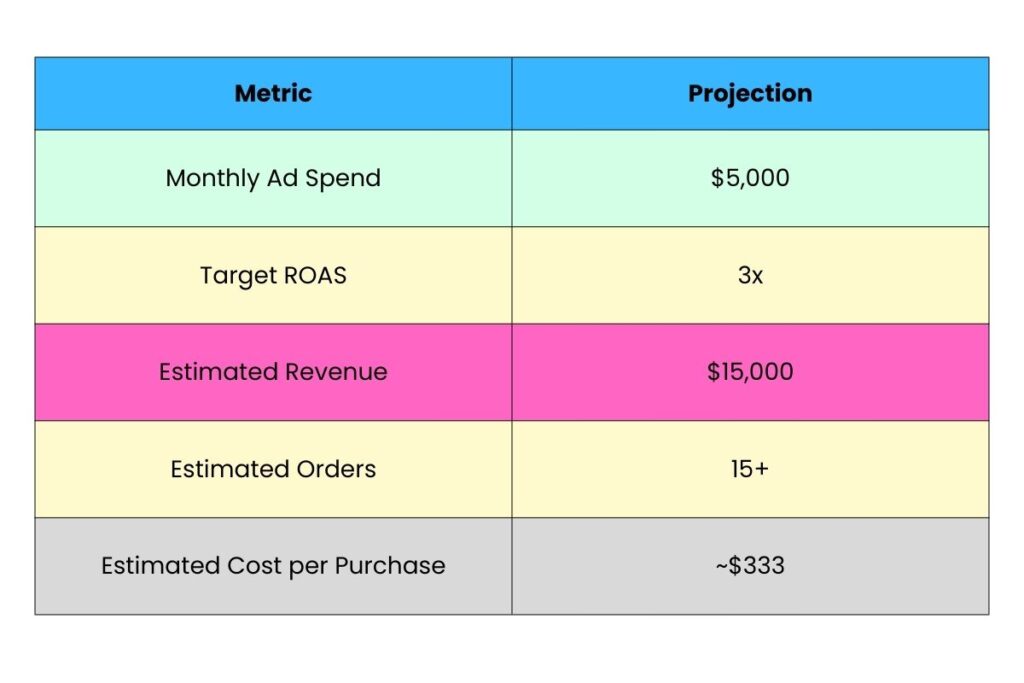
Because the average order value is high, even a relatively small number of monthly conversions can produce meaningful revenue.
Scaling the System
Once the advertising system begins producing consistent results, scaling becomes the next step.
Scaling does not mean suddenly doubling the advertising budget. Instead, growth should occur gradually while maintaining performance stability.
Three approaches can drive long-term expansion.
Increasing budgets on top-performing campaigns by twenty to thirty percent each week allows the algorithm to adapt without destabilizing results.
Lookalike audiences built from purchasers and high-value customers can expand the reach of campaigns while maintaining similar audience characteristics.
Finally, advanced campaign types such as Advantage+ shopping campaigns can automate much of the optimization process, allowing Meta’s machine learning system to identify new conversion opportunities.
Final Reflection
Luxury products demand a different marketing mindset. The focus is not on aggressive sales tactics but on creating a brand experience that resonates with the right audience.
For a luxury footwear brand like Rondyce, Meta advertising offers a powerful opportunity to combine storytelling with performance marketing.
When creative storytelling, structured funnels, and accurate tracking systems work together, paid advertising evolves from a simple traffic source into a scalable revenue engine.
This strategy demonstrates how a carefully designed Meta Ads framework could help a luxury brand move from limited visibility to consistent growth in the competitive digital fashion market.
Transparency Note
This is a hypothetical strategy case study created to demonstrate how a structured Meta Ads strategy could scale a luxury fashion brand.
The purpose of this case study is to showcase a strategic framework for growth using paid social advertising.