

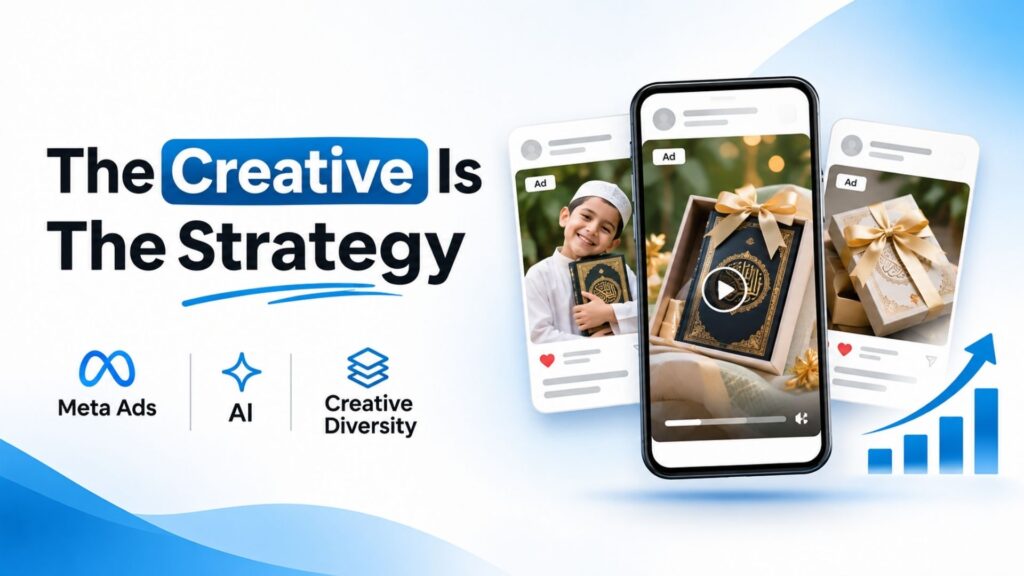
For years, advertisers spent a lot of time finding the perfect audience.
They tested interests, adjusted demographics, created lookalike audiences, and built complicated targeting structures.
But digital advertising is changing.
Today, artificial intelligence plays a much bigger role in deciding which ads people see. Platforms like Meta are becoming better at understanding user behavior and matching ads with people who are more likely to respond.
So, what does this mean for advertisers?
It means your creative deserves more attention than ever.
A well-designed ad is no longer just something that makes a campaign look attractive. It communicates your offer, captures attention, builds trust, and gives advertising platforms more opportunities to find the right customers.
Your targeting helps guide delivery. Your creative gives people a reason to care.
1. Advertising Has Changed. Your Strategy Should Too.
Traditional advertising strategies often focused heavily on audience segmentation.
Advertisers created different ad sets for different interests, ages, locations, and behaviors. The goal was to find a small audience that matched the ideal customer.
Audience targeting still matters. But modern advertising platforms use advanced machine learning to help automate much of the audience-selection process.
Meta’s Andromeda system is one example.
It is an AI-powered ad retrieval system designed to identify relevant ads from a very large pool of advertising candidates. Meta has continued developing this technology to improve how ads are matched with people.
This changes how advertisers should approach campaign preparation.
Instead of spending most of your time creating more audience segments, you should also focus on creating meaningful differences between your ads.
Different messages, visuals, formats, and creative concepts give the platform more options to match with different people.
The goal is not simply to produce more ads. It is to produce more useful variations.
2. What Does Creative Strategy Actually Mean?
Creative strategy is the process of deciding what your advertisement should communicate, how it should look, and why someone should care.
It goes beyond graphic design.
A strong creative strategy answers four important questions:
- Who are we trying to reach?
- What problem does this person have?
- Why should they choose this product or service?
- What message will encourage them to take action?
For example, imagine you are advertising a personalized gift.
One advertisement could focus on the product’s appearance.
Another could show the emotional reaction of someone receiving the gift.
A third could explain the personalization process.
All three promote the same product. But they communicate different reasons to buy.
This is the difference between changing an image and developing a creative strategy.
3. Creative Diversity Matters More Than Repeating the Same Ad
One common mistake is creating several advertisements that look almost identical.
The background changes. The product moves to another position. The headline is slightly different.
But the main message remains the same.
This does not necessarily give your campaign meaningful creative diversity.
Meta Blueprint’s 2026 training on creative diversification highlights the importance of varying formats, visuals, and messaging. Its published training materials also report performance improvements from visually distinct creative assets in large-scale Meta ad tests. These results should not be treated as a guaranteed outcome for every business.
Consider testing different creative approaches:
Product-focused creative: Show the product, its features, and its benefits.
Problem-solving creative: Explain a problem and demonstrate how your product solves it.
UGC-style creative: Use natural, relatable content that feels like a real customer experience.
Storytelling creative: Show a situation that helps people connect emotionally with your offer.
Offer-focused creative: Communicate pricing, promotions, bundles, or other reasons to purchase.
Each approach gives people a different reason to pay attention.
And that is what creative diversity should achieve.
4. The First Three Seconds Can Make a Difference
People scroll quickly.
Your advertisement competes with entertainment, personal updates, news, and thousands of other pieces of content.
You have very little time to communicate why someone should stop.
That is why the opening hook matters.
A hook is the first message, visual, or moment that captures attention.
For example, instead of starting a product video with a slow introduction, show the most interesting product feature immediately.
Instead of saying, “Welcome to our store,” start with a question that addresses a customer problem.
Here are three simple hook examples:
- “Still looking for a meaningful gift?”
- “Your next favorite product might be this one.”
- “Here’s why customers love this personalized gift.”
However, attention alone is not enough.
A strong hook should connect naturally with the rest of the advertisement. If the opening creates curiosity but the product does not deliver on that promise, people may leave without taking action.
The hook earns attention. The message builds interest. The offer encourages action.
5. AI Can Help You Create Better Advertising
AI is changing the creative production process.
Advertisers can now use AI tools to generate visual concepts, explore different backgrounds, create copy variations, adapt images, and develop video ideas.
Meta has also introduced AI-powered creative features within its advertising ecosystem.
These tools can reduce production time and help businesses explore more creative directions.
But there is an important difference between generating content and developing a strategy.
AI can create ten variations of an advertisement in minutes.
It cannot automatically guarantee that those ten variations communicate the right message to your customers.
That responsibility still belongs to the advertiser.
Use AI to support research, brainstorming, production, and testing. Then review every creative for accuracy, brand consistency, relevance, and customer appeal.
AI can accelerate creative production. Strategy gives that creativity direction.
6. How to Build a Practical Creative Testing System
You do not need a huge creative budget to start testing.
You need a structured approach.
Here is a simple process:
Step 1: Identify the customer problem.
Understand what your audience wants, what challenges they face, and what motivates them to purchase.
Step 2: Develop different creative angles.
Choose a few distinct messages. For example, product benefits, customer problems, emotional value, and social proof.
Step 3: Test different formats.
Try short-form videos, product images, demonstrations, UGC-style content, and carousel ads where appropriate.
Step 4: Measure meaningful results.
Look beyond likes and impressions. Review metrics such as click-through rate, cost per result, conversion rate, cost per purchase, and return on ad spend.
Also consider hook rate and video retention when evaluating video advertisements.
Step 5: Learn and improve.
Identify which messages attract attention, which generate qualified traffic, and which contribute to actual conversions.
Then use those findings to develop your next creative ideas.
Remember, a creative that generates cheap clicks is not automatically a winning creative. The real objective is to attract the right customers and support profitable business growth.
7. The Real Strategy Is Bigger Than the Advertisement
Creative is extremely important, but it does not work alone.
A successful advertising system also needs:
- A clear product or service offer.
- A well-designed landing page.
- A smooth customer journey.
- Accurate conversion tracking.
- A reliable optimization process.
- A strong connection between advertising and business goals.
Imagine an advertisement generates hundreds of clicks but the landing page fails to explain the offer.
Or a campaign generates orders, but conversion tracking records inaccurate data.
In both situations, improving the creative alone will not solve the entire problem.
That is why creative strategy, advertising, tracking, and conversion optimization should work together.
Final Thoughts: Stop Just Making Ads. Start Building Creative Strategies.
The advertising landscape is becoming more automated.
AI is helping platforms make smarter delivery decisions. Creative tools are making production faster. And businesses have more opportunities to test different messages and formats.
But technology does not remove the need for human understanding.
You still need to understand customers, communicate real value, and develop ideas that make people care about your offer.
The businesses that approach creative as a strategic part of marketing—not just a design task—will be better prepared to adapt to this changing environment.
Because the goal is not to create more advertisements.
It is to create better reasons for customers to choose your business.
The creative is not just what people see. It is what gives your advertising strategy a voice.
Written by Mr. Nur | Meta Ads, Google Ads & Tracking Specialist