

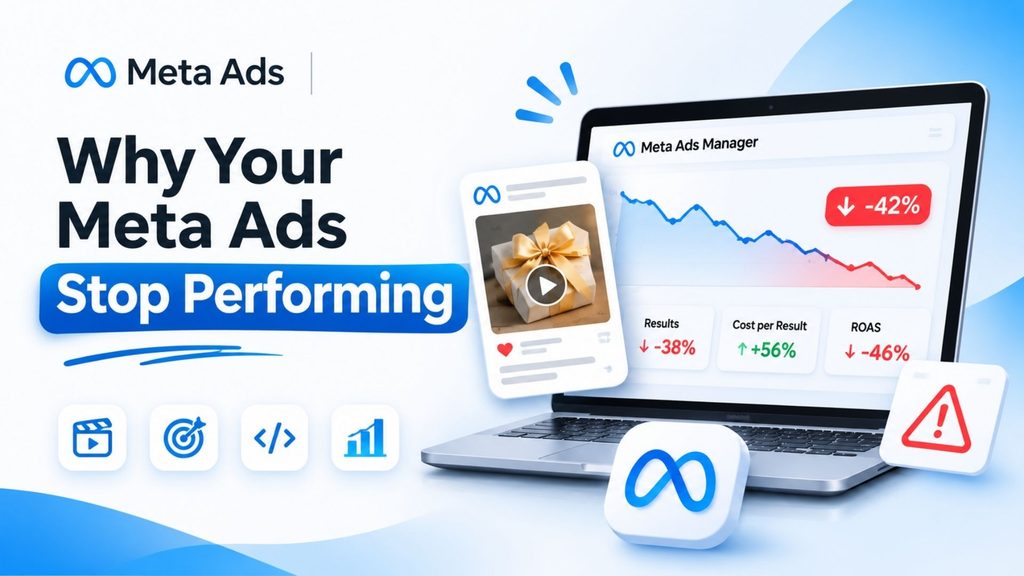
Your Meta Ads campaign was performing well.
You were getting consistent sales. Your cost per purchase was reasonable. Everything looked good.
Then suddenly, things started changing.
Your cost per result increased. Sales became inconsistent. Your budget was spending, but the results were not the same.
Sound familiar?
This is one of the most common challenges in digital advertising.
But here is something important: A decline in Meta Ads performance does not always mean your campaign is broken.
There could be several reasons behind it. And changing your targeting or increasing your budget without understanding the problem can make things worse.
Let’s look at seven common reasons why Meta Ads stop performing and what you can do about them.
1. Creative Fatigue: People Have Seen Your Ads Too Many Times
One of the most common reasons for declining performance is creative fatigue.
It happens when people repeatedly see the same advertisement and gradually lose interest.
Your video, image, or message may have performed well initially. But over time, people may stop paying attention.
You might notice:
- Lower click-through rates.
- Increasing cost per result.
- Declining video engagement.
- Rising frequency alongside weaker results.
However, frequency alone does not prove creative fatigue. Always compare it with actual performance trends.
What should you do?
Introduce new creative concepts instead of simply changing the background or headline.
Test different hooks, product angles, video formats, customer problems, and messaging.
The objective is to give your audience new reasons to pay attention.
2. Your Campaign Is Stuck in the Learning Phase
Meta’s advertising system uses machine learning to optimize delivery.
When you launch a new ad set or make certain significant changes, the system may need time to learn how to deliver your ads effectively.
During this period, performance can be unstable.
Frequent changes can make the situation worse.
For example, repeatedly changing budgets, audiences, optimization settings, or campaign structures can disrupt delivery and trigger another learning period.
What should you do?
Avoid unnecessary changes.
Give your campaign enough time and conversion opportunities to collect useful data.
Meta commonly references approximately 50 optimization events within seven days as a learning-phase benchmark. However, this is not a guarantee that every campaign will become profitable after reaching that number.
Focus on a stable setup rather than constantly editing your campaigns.
3. Your Audience Is Too Narrow
A very narrow audience can limit your campaign’s ability to find new potential customers.
This becomes especially challenging when your budget is high compared with the available audience.
The same people may repeatedly see your advertisements. As a result, reach can become limited and advertising costs may increase.
Modern Meta advertising increasingly relies on AI-powered delivery and broader audience discovery.
That does not mean targeting no longer matters. It means advertisers should avoid unnecessary restrictions when those restrictions limit useful delivery opportunities.
What should you do?
Review your audience size and delivery.
Test broader targeting where appropriate. Consider Advantage+ audience features and allow the system to explore potential customers.
Most importantly, provide different creative messages that appeal to different customer needs.
4. Your Tracking Data Is Inaccurate
Sometimes your campaigns are generating sales, but Ads Manager is not reporting them correctly.
This can happen because of:
- Incorrect Meta Pixel implementation.
- Missing or duplicated conversion events.
- Conversion API configuration problems.
- Event deduplication errors.
- Missing or inconsistent event parameters.
When tracking data is unreliable, Meta may receive incomplete conversion signals.
That makes it harder to understand campaign performance and optimize toward the right outcomes.
What should you do?
Check Events Manager and review your Pixel and Conversions API setup.
Test important events such as ViewContent, AddToCart, InitiateCheckout, and Purchase.
Verify that browser and server events are configured correctly and that event deduplication is working as intended.
Remember, better advertising decisions start with reliable data.
5. Your Competitors Are Becoming More Aggressive
Meta Ads operates through an advertising auction.
You are competing with other advertisers for opportunities to reach people.
When competition increases, your cost per thousand impressions (CPM) may also increase.
This can happen during seasonal promotions, major shopping events, or periods when competitors increase their advertising budgets.
Even if your campaign setup has not changed, your results may become more expensive.
What should you do?
Monitor CPM, CTR, cost per result, and conversion rate together.
Review your offer and creative against competing alternatives.
Do not automatically blame targeting when the real issue may be increased auction costs.
6. Your Offer or Website Is Not Converting
Not every advertising problem starts inside Ads Manager.
Sometimes your advertisement is doing its job.
People are clicking. They are visiting your website. But they are not completing purchases.
This suggests that the problem may be happening after the click.
Common reasons include:
- A confusing product page.
- Slow website loading.
- Unexpected delivery charges.
- Weak product descriptions.
- Lack of customer trust.
- A complicated checkout process.
- An offer that is less attractive than competitors’ offers.
What should you do?
Review the complete customer journey.
Compare link clicks with landing-page views, add-to-cart events, checkout activity, and purchases.
Check your website on mobile devices. Make sure your offer is clear and your checkout process is simple.
More traffic cannot solve a conversion problem by itself.
7. You Are Optimizing the Wrong Metrics
A campaign can generate impressive engagement without producing meaningful business results.
For example, thousands of video views do not automatically mean more customers.
Similarly, cheap clicks do not guarantee profitable sales.
Your optimization decisions should reflect your actual business objectives.
For an e-commerce business, important metrics may include:
- Cost per purchase.
- Conversion rate.
- Average order value.
- Return on ad spend (ROAS).
- Cost per delivered order, when using cash on delivery.
For lead generation, qualified leads and cost per qualified lead may matter more than total lead volume.
What should you do?
Connect your advertising metrics with your business results.
Do not judge a campaign using only one metric.
Understand which results contribute to revenue and profitability.
How to Diagnose a Meta Ads Performance Drop
Before making changes, follow a simple process.
Step 1: Identify when the performance changed.
Compare your recent results with the previous stable period.
Step 2: Review the creative.
Check frequency, CTR, video engagement, and cost per result.
Step 3: Check campaign changes.
Review your account history for recent budget, audience, or optimization changes.
Step 4: Verify tracking.
Make sure your Pixel, Conversion API, and conversion events are working correctly.
Step 5: Review the website and offer.
Check whether people are completing the customer journey after clicking your ads.
Step 6: Evaluate auction conditions.
Look for changes in CPM and overall delivery costs.
This approach helps you identify the actual problem instead of making random campaign adjustments.
Final Thoughts: Don’t Just Change Your Ads. Understand the Problem.
Meta Ads performance can change for many reasons.
Sometimes your creative becomes less effective. Sometimes your audience becomes limited. Sometimes tracking breaks or your website stops converting.
And with AI playing an increasingly important role in advertising delivery, campaign optimization requires more than simply adjusting audience settings.
You need to understand the relationship between creative, targeting, tracking, website experience, and business results.
My recommendation is simple:
Before changing a campaign, understand why its performance changed.
Because better optimization does not start with more changes.
It starts with better decisions.
Written by Mr. Nur | Meta Ads, Google Ads & Tracking Specialist